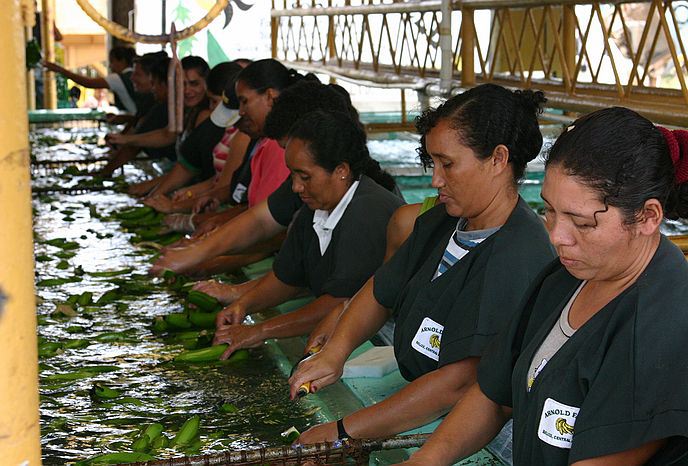
Though average person gives little thought to their breakfast banana, the widely consumed fruit represents a long history of economic, political, environmental and social injustices in the global trade market. Plantation workers across South and Central America have been routinely exploited to provide low prices to consumers around the world. As early as the 1900s, multinational corporations maintained a virtual monopoly over so-called banana republics, leaving a lasting impact on the development of many Latin American countries. The United Fruit Company in particular was accused of bribing government officials for preferential treatment and underpaying farmers who worked in unsafe conditions. Today, global pressure from retailers and distributers to maintain low prices results in an oppressive environment for banana plantation workers.
In the 1960s, an organized social movement called fair trade emerged out of anti-big corporation sentiments. Fair trade’s central aim is to alleviate poverty among farmers in developing economies, improve living standards, and spare the environment from destructive chemicals. To achieve these objectives, it advocates a “more equitable distribution of the pie for farmers and laborers” by offering them a premium for crops such as coffee beans and bananas.
Despite its well-intentioned nature, the Fair Trade movement has stirred controversy in recent years. Fair Trade USA, the leading fair trade organization in the U.S., cut ties with its international counterpart in an effort to distribute produce with the fair trade label to larger corporations. Through these efforts, Fair Trade USA seeks to increase fair trade’s far-reaching impact. However, expanding its mission comes at the cost of changes that lower fair trade’s standards: The organization pledged to label products with only 10 percent fair trade ingredients, as opposed to a minimum of 20 percent required in other countries. As articulated by chief executive of Fair Trade USA Paul Rice, the question remains: “Do we want it to be small and pure or do we want it to be fair trade for all?”
Sources:
http://en.wikipedia.org/wiki/United_Fruit_Company
http://www.globalissues.org/article/63/the-banana-trade-war
http://www.freshplaza.com/article/119277/Equal-exchange-talks-big-change-in-bananas-at-conference
http://www.nytimes.com/2011/11/24/business/as-fair-trade-movement-grows-a-dispute-over-its-direction.html?_r=1&adxnnl=1&pagewanted=all&adxnnlx=1396499384-evHsWCiH3GiTEJMHXvFxfw


