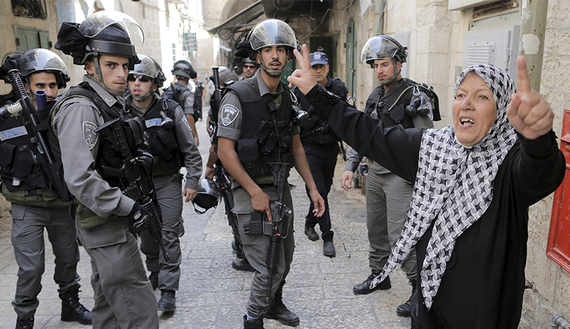
Israeli police block a Palestinian woman’s access to the Haram al-Sharif/Temple Mount (Photo Credit Al-Monitor/Reuters-Ammar Awad)
As if to spite the upcoming Jewish holiday of Rosh Hashanah and the Islamic holy days of Dhul Hijjah, violence broke out near the Al-Aqsa Mosque in Jerusalem last Sunday. The area, of religious importance to both traditions, became the site of clashes between Israeli security forces and Muslim worshippers when police tried to secure the compound. Though unrest and mild clashes are not unusual near the Mosque close to religious holidays, the conflict has, and continues to escalate. Palestinian youth, in defense of the mosque, constructed wooden barriers and have hurled stones and fireworks at police. Israeli police, in turn, have positioned officers on the complex’s rooftops, and have used stun and sound grenades, tear gas, and rubber bullets against Palestinians.
The eruption of violence is due, in part, to the status and importance of Al-Aqsa. Known as Al-Haram Al-Sharif, or the Noble Sanctuary to Muslims, the mosque is one of the holiest sites in the Islamic faith. For Jewish worshippers, the complex is known as the Temple Mount, and is believed to be the site of both Jewish Temples. For centuries, Jews prayed only at the Western Wall, the last remnants of the Second Temple. Since 1967, though, Jews have been allowed to enter, though not pray at, the Temple Mount complex. In recent years, the inflow of Jewish activists and visitors has jumped dramatically, from 5,658 in 2009 to almost 11,000 last year. A number of right-wing groups, and even members of the Knesset, have also indicated a willingness to change the current status of the mosque. This has prompted fears Israel might attempt to alter the sovereignty of or access to the mosque. Such a move would not be unprecedented; access to Al-Aqsa is already frequently restricted for Muslim men under the age of 40, and similar arrangements were made to the city of Hebron in the 1990s, when Israel placed the famous Al-Ibrahimi Mosque under its control during the partition of the city. Tensions run even higher at the moment due to an Israeli Defense Ministry decision earlier this month, in which two Palestinian groups protesting Israeli visits to the Temple Mount were declared illegal and banned from protesting. The Ministry accused the groups of inciting violence, while members argue they have the right to protest on Al-Aqsa’s grounds. The critical importance of Al-Aqsa and fears the Israeli government will increase its sovereignty over it have made it a flashpoint for the broader Israeli-Palestinian conflict.
The international community has been on edge as well. Jordan, the designated custodian of Al-Aqsa, has warned Israel current violence might lead to a downgrade in their relations. The UN Security Council issuing a statement this Thursday expressing “grave concern” about the violence. King Salman of Saudi Arabia has appealed to UN Secretary Ban Ki-moon for action in light of the clashes. President Recep Tayyib Erdogan of Turkey has expressed his concern over the violence, speaking with German Chancellor Angela Merkel and French President Francois Holland earlier this week.
Unfortunately, the increase in concern by officials has done nothing to quell the violence. Officials say more than 3000 police officers were deployed in the first three days of the fighting alone. Earlier this week, Prime Minister Netanyahu requested the Attorney General to grant permission for snipers to use low-velocity rifles against Palestinian stone throwers, and deployed more than 800 additional troops in Jerusalem. The violence has since left the compound and spread throughout East Jerusalem, with some accounts stating that over 60 people have been injured in the course of the riots. This Friday alone, dozens of people were injured in clashes with police near Al-Aqsa. While one might hope the religious importance of this time of year would quell sentiments, no immediate end to the violence is in sight.


