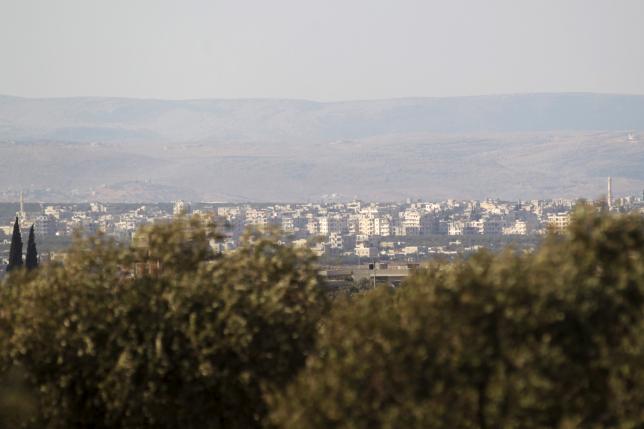
A view shows the Shi’ite Muslim town of al-Foua in northwestern Syria, September 22, 2015. REUTERS/Khalil Ashawi
Only a few days after a UN-brokered ceasefire in four Syrian towns was agreed to by regime-allied and rebel forces, reports of the ceasefire being broken by both government and rebel forces emerged. The deal was posed to be unlike any prior agreement in the Syrian conflict: endorsed by Iran and Turkey, agreed to by Hezbollah and anti-Assad insurgent groups, spanning two front lines, and originally intended to last for six months, the truce was significantly longer than the oft-negotiated 48-hour ceasefires in Syrian cities. In the northwestern province of Idlib, up to 10,000 Shia Muslims would be evacuated from the border towns of al-Foua and Kefraya. In turn, Shia militias would halt their siege of the rebel-controlled city of Zabadani and allow up to 500 rebel fighters to withdraw from the city and relocate to Idlib. Humanitarian assistance would also be provided to all ceasefire areas for two weeks before the population evacuations began. An unnamed diplomatic source even claims Hezbollah fighters would withdraw from the Syrian conflict after the fight for Zabadani ended.
How was a longer-term agreement, brokered by international organizations and governments representing both parties, broken so quickly? Early reports from the Syrian Observatory for Human Rights indicate rebels fired shells into the village of al-Foua, an area covered under the ceasefire, after government forces allegedly shot into the nearby town of Taftanaz. Yet, it is unclear whether Taftanaz was included in the ceasefire agreement. Furthermore, it appears only rebel groups and regime-allied forces, not the Syrian regime itself, were involved in the negotiations. If the regime was not party to the negotiations, or if the areas of the ceasefire are unclear, the conflict risks escalating from a single ceasefire violation to an overall increase in hostilities.
None of this is to say that hope is lost for the agreement. The violation only occurred in the northwest province of Idlib, and not the city of Zabadani. Even after the shelling of al-Foua, the ceasefire is reported to have held on in the area. It is still far too early to tell if the ceasefire will last for the entirety of its proposed 6-month timeframe. While parties have an incentive to attack an unprepared enemy prior to the end of a ceasefire in shorter agreements, this deal’s duration might prevent such violations. Should the deal persist, though, it will not only give Syrians a respite from the violence, but could possibly be built upon to provide a platform for additional, long-term Syrian peace agreements.


