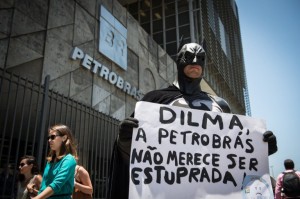
A man dress as batman with a sign that reads, “Dilma, Petrobras deserves not to be raped.”
Brazil’s state-run oil giant Petrobras is involved in one of the nation’s biggest corruption scandals to date. The ordeal began in March of 2013 when police arrested Paulo Roberto Costa, Petrobras’ Chief of Refining, in suspicion of money laundering. In a bid for sentencing leniency, Costa admitted to a much larger corruption scheme. Authorities allege that top executives of Petrobras created a kickback system that involved soliciting bribes from construction companies to divert to political parties. The bribes amounted to two to three percent of each contract signed with Petrobras and was distributed to political parties within Brazil, including the Brazilian Democratic Movement Party, the Progressive Party, and President Dilma Rousseff’s Workers’ Party. In a months-long investigation dubbed Operation Car Wash, police identified 10 billion reais ($3.7 billion) of suspicious payments. In response, in November of 2014, Brazilian police carried out a series of raids that resulted in the arrest of 23 people. Among them was Renato Duque, former Petrobras service director, and 19 presidents and executives of some of Brazil’s six largest construction companies.
In response to petrolão (the “big oily), the public protested on the streets of Brazil. Many opposition leaders to Rousseff’s Workers Party called for her immediate impeachment and resignation. President Rouseff previously headed Petrobras’ board of directors and has a long political record of championing the oil industry. Despite the shared history, there has been no evidence that Rousseff had any knowledge of the illegal practices within the company. The scandal certainly affected the President’s October reelection bid and amounted in a narrow victory over her opposition. Earlier this month, President Rousseff decided to replace Maria das Graças Silva Foster as chief executive of Petrobras. Foster was a close friend of Rousseff and handpicked by her for the executive position after months of mismanagement of the oil-company. This shakeup of the management team was executed after claims that Foster and other senior executives were aware of the financial irregularities within the company. Even with the changes, Rousseff’s public ratings have sunk to all-time lows. According to a Reuter’s poll, three in four of Brazilian’s believe that the president had some knowledge of the alleged corruption during her time as chairwoman from 2003 to 2010.
Moreover, debt continues be a growing problem for Pertrobras and subsequently the Brazilian economy. The corruption scandal has largely decreased Petrobras’ ability to refinance its debt in order to meet its massive capital expenditure requirements. In October of 2014, Moody’s Investors Services downgraded Pertrobras’ debt rating citing additional concerns about the fallout of the scandal and falling oil prices. This is particularly problematic because of Petrobras’ importance to the Brazilian economy. As The New York Times reported, Petrobras “produces more than 90 percent of the country’s petroleum, owns all of the nation’s refineries, operates more than 21,000 miles of pipelines, dominates wholesale gas and diesel distribution, and even owns the largest chain of service stations”. According to Samuel Pessoa, an economist at the Fundação Getulio Vargas in Rio de Janeiro, Petrobras along with its subcontractors were responsible for about a tenth of Brazil’s economic output.
Furthermore, Operation Car Wash has additionally forced the company to ban new contracts, restricting capital back into the company. This paralyzed spending is poised to affect investment within the country and consequently the Brazilian economy. As The Economist reports, “the affair may cost up to 1% of GDP in forgone investment”. On February 24th, Moody once again cut the Petrobras’ debt rating to junk status; this means that if the company fails to publish audited results it soon may be unable to borrow at all to repay its debts. President Rousseff’s administration must take the necessary steps keep the company afloat, thus preventing a possible recession on the Brazilian people. Due to Petrobras’ outsize role in Brazil’s economy, there looks to be no other option than the treasury lending a hand. If the company were to default, the repercussions would be felt throughout every industry and marketplace. Additionally, Petrobras’ subcontractors in construction and engineering will have to cut spending or sell assets in order to avoid bankruptcy. Both outcomes would severely impair Brazil’s growth, a worst-case scenario for the nation. Clearly, the entire Brazilian economy is at risk if Petrobras declares bankruptcy, which is precisely why the Rousseff administration should be inclined to provide a bailout or other helpful measures to the debt-ridden company.
Sources:
http://www.economist.com/news/americas/21637437-petrobras-scandal-explained-big-oily
http://www.cnbc.com/id/102212048#.
http://www.reuters.com/article/2015/02/25/us-brazil-petrobras-politicians-idUSKBN0LT2DP20150225
http://www.nytimes.com/2015/02/05/world/americas/petrobras-executives-leaving-amid-brazilian-graft-scandal.html?_r=0
http://dealbook.nytimes.com/2015/02/11/a-corruption-scandal-at-petrobras-threatens-brazils-bond-market-and-economy/
Photo Credits belong to AFP.

![Barack Obama and Raúl Castro shake hands as they meet for the first time at the 2015 Summit of the Americas in Panama [Photo Credit: Reuters]](../../../wp-content/uploads/2015/12/image-resizer-50x50.jpg)
![Macri celebrates winning enough votes to force Argentina into a runoff election [Photo Credit: AFP]](https://keckjournal.com/wp-content/uploads/2015/11/arg-50x50.jpg)
