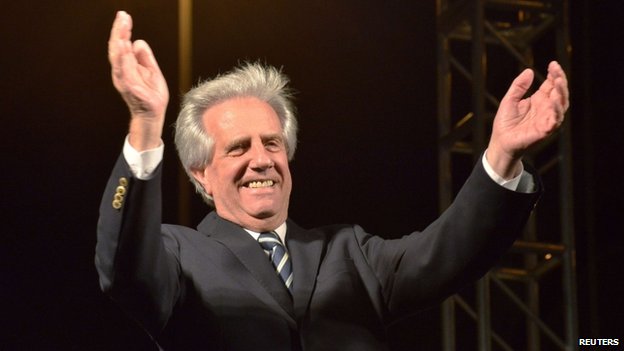
On November 30th, Uruguayan voters made it abundantly clear that they were not in the mood for change by re-electing Tabaré Vázquez as President, a position he previously held from 2005 to 2010. This re-election came amid a robust year of economic growth with the nation’s economy growing an unprecedented 4.4% last year. Last Sunday’s decisive victory was during the second round of the runoff elections against Luis Lacalle Pou, the National Party Candidate. With a 10 percent margin of victory, Mr. Vázquez once again secured a left-leaning government that will govern closely with the newly elected Broad Front majority in Congress. Mr. Vázquez’s performance surprised very few after he left office in 2010 with an approval rating of over 60%, and a growing economy to his name. Many have attributed this growth to the economic policy of the Broad Front, the left-leaning political coalition that Mr. Vázquez and his predecessor President Jose Mujica belong to. President Mujica continued this legacy into his term, subsequently establishing a left-leaning political dominance.
Both Pou and Vázquez come from very different backgrounds. Pou, son of a former president, is a lawyer educated in private schools. His young age and privileged background made it difficult for the ordinary Uruguayans to find common ground with him, leading to fewer votes. On the other hand, Vázquez is the son of a union leader and grew up in a working class neighborhood. During his first term in office, he donated up to 90% of his presidential salary to charity. Vázquez’s favorability rating goes far past his charitable character and is the product of his very successful first term in office. He is perceived to be the people’s man, and a trustworthy household name.
The runoff election captured international headlines for its most controversial issue: marijuana. Particularly, Vázquez’s opponent, center-right candidate Luis Lacalle Pou, promises to undo a great deal of the plan that would allow the state-controlled production, distribution, and sale of cannabis. While Mr.Vázquez has expressed concern over the marketing system and the pharmacies role in the distribution of cannabis, he has promised to enforce the pioneering legislation unless it produced negative results. Furthermore, despite being praised by the global community, the majority of the Uruguayan people do not support the legalization of marijuana. Amid confusion around the exact details of the controversial legislation recent polls have determined that an overwhelming majority of Uruguayans disagree with the Mujica administration in spite of the promised economic gain. This ideological conflict will be one of many political challenges Vázquez faces when he reassumes the presidency.
Vázquez also ran on a more centrist platform compared to his predecessor and successor, President Mujica. A former urban guerilla fighter, José Mujica’s first term in office was marked by legislation that legalized abortion, same-sex marriage, and established a marijuana market. While Vázquez vows to continue Mujica’s liberal agenda into his term, his first term in office demonstrates his more conservative position. Nevertheless, it would be unprecedented for a politician to go against his own party, so one can expect Vázquez to follow a more socially liberal agenda during his next term.
Victory was only the first step. When Vázquez assumes office in 2015, he will be facing some of the most harrowing crime and education statistics. The number of muggings has increased fivefold in the past 20 years, and murder too rose by 80%. Uruguay’s education system is also in need of reform. In a 2012 report, Uruguay ranked 56th among 65 countries in the Organization of Economic Co-operation and Development’s (OECD) PISA test of competence in math, reading, and science. The test measures the scholastic performance of 15-year-old school pupils of members of the OECD and non-members. Despite the failure to tackle these issues, the Uruguayan people trust the continuation of the Broad Front coalition to improve the country’s future situation, as they did with the economy in the past. All in all, that is what the November election came down to: continuity rather than change. Uruguay will once again have Tabaré Vázquez as its presidente until 2020.
Sources :
http://www.nytimes.com/2014/12/01/world/americas/leftist-tabar-vzquez-reclaims-presidency-in-uruguay-election.html
http://www.usatoday.com/story/news/world/2014/11/30/ex-president-wins-uruguay-election-pot-plan-safe/19718183/
http://www.reuters.com/article/2014/11/30/us-uruguay-election-idUSKCN0JE04C20141130
Photo credit: BBC

![Barack Obama and Raúl Castro shake hands as they meet for the first time at the 2015 Summit of the Americas in Panama [Photo Credit: Reuters]](../../../wp-content/uploads/2015/12/image-resizer-50x50.jpg)
![Macri celebrates winning enough votes to force Argentina into a runoff election [Photo Credit: AFP]](https://keckjournal.com/wp-content/uploads/2015/11/arg-50x50.jpg)
