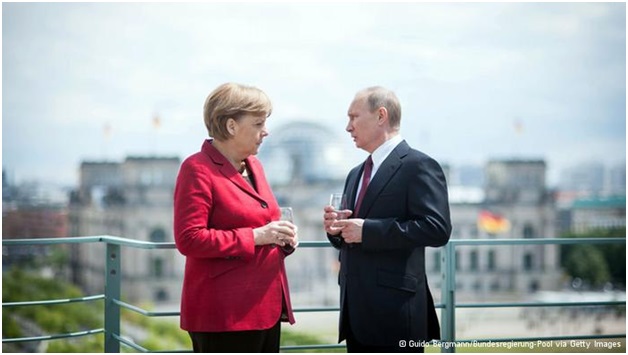
On March 27, 2014, Angela Merkel said that the West “has not reached a stage that implies the imposition of economic sanctions” against Russia, continuing that she hopes to avoid using them at all, working instead “on de-escalation of the situation,” instead of escalation.[1] This position might seem odd for a European power facing a belligerent neighbor that does not respect territorial sovereignty. However, the economic concerns that Germany faces as a result of increased EU sanctions against Russia appear to overshadow Merkel’s security concerns.
Most importantly, Germany relies on Russia for energy imports.[2] This week, German Federal Minister of Economics and Energy, Sigmar Gabriel, said that there are no reasonable alternatives to Russian oil and natural gas, at least for the time being.[3] A 2012 report by the International Energy agency demonstrates Germany’s bind. The country has very little oil or natural gas production and relies almost exclusively on imports. Oil still accounts for 32 percent of energy consumption in the country.[4] Because Germany buys 30 percent of all Russian energy exports, it is unlikely that Russia would stop delivering it, however, an escalation in the standoff between Russia and the G-7 could cause devastating increases in energy prices. Additionally, over 6,000 German companies remain engaged in trade and business in Russia, with Russia coming in as Germany’s seventh biggest import market in 2013.[5] Trade between the two countries amounts to over 76 billion euros, which has led German business leaders to urge caution and show concern over EU sanctions against Russia.[6]
Another factor in Merkel’s attitude is undoubtedly the German population’s reaction to the sanctions. A poll this week by Der Spiegel magazine showed that 54 percent of respondents thought that the West should accept the annexation and also that 55 percent had some or a lot of understanding for Putin’s geopolitical concerns that led him to take the peninsula.[7]
Angela Merkel’s remarks this week show that although she disapproves of Putin’s actions, she is not willing to go down a road of no return. As she and other world leaders scramble to find a diplomatic solution to the Crimea Crisis, she is working to de-escalate the situation instead of punishing Putin. This alternative perspective seems jarring after weeks of national discussions comparing Putin’s annexation of Crimea to Adolf Hitler’s annexation of the Sudetenland. This comparison is naturally tempting to make, but perhaps they twist the conversation to a predetermined conclusion. Today’s leaders will have to determine how to handle a twenty-first century belligerent power within today’s context. Is Merkel remarkably naïve to ignore the historical parallels, or remarkably wise to avoid drawing them?
[1] “German chancellor against imposition of economic sanctions on Russia,” ITAR-TASS News Agency, March 27, 2014, http://en.itar-tass.com/world/725463.
[2] “Merkel highlights Russia sanctions during visit by Canada’s Harper,” Deutsche Welle, March 27, 2014.
[3] “Gabriel sieht keine echte Alternative zu russischem Gas,” Epoch Times, March 28, 2014.
[4] “Oil and Gas Security: Emergency Response of IEA Countries: Germany,” International Energy Agency, 2012, 3.
[5] “Above 6,000 German companies to be hit by sanctions on Russia- export body,” RT, March 21, 2014.
[6] Chris Bryant, “German Business Concerns Grow Over Russia Ties,” The Financial Times, March 27, 2014.
[7] “Umfrage: Jeder Dritte hält Sanktionen des Westens in Krim-Krise für “übertrieben,” Epoch Times, March 23, 2014. http://www.epochtimes.de/Umfrage-Jeder-Dritte-haelt-Sanktionen-des-Westens-in-Krim-Krise-fuer-uebertrieben-a1139805.html.

Related posts
![Migrants at a train station in Dortmund, Germany. [Photo Credit Times of Israel/AP Photo/Martin Meissner]](https://keckjournal.com/wp-content/uploads/2015/09/Germany-Migrants_Horo-4-635x357-50x50.jpg)
Europe’s Migrant Crisis: The Region’s Past, Present, and Future

UK and EU: “Brexit” or No?
