The transfer of sovereignty over Hong Kong, the Handover, marked the end of British influence in the tiny islands near the southernmost point of China. For nearly a century this strategic port of East Asia had been central to the opium trade, and more largely, British naval dominance [1]. The British never offered full self-government to their colony during their 99-year lease term from 1898 to 1997 — at which point Mainland China assumed control over the territory and permitted a “One Country, Two Systems” governing approach in which it granted Hong Kong a high degree of autonomy, know as Basic Law [2]. Throughout the colonization period, Hong Kong had actually been governed by a British colonial appointee [2]. Additionally, Britain imposed their legal system, educational system, and culture on the colony for over a century [2]. Meanwhile, Hong Kong prospered, becoming the economic envy of the world. Perhaps the citizenry didn’t notice their lack of choice when life seemed fair, easy, and to their liking. Why is Home Rule or Universal Suffrage important to Hong Kong now?
Since the 1997 handover to Mainland China and until fairly recently, Hong Kong has been allowed, more or less, to continue operating the way it always had. The British legal and educational systems were maintained and, aside from minor squabbles, the Mainland did not seek to overtly impose communist culture or to censor thought or speech [2]. This pleased the populace, many of whose descendants had originally emigrated from the Mainland to Hong Kong in order to escape the persecution and lack of freedoms that filled the decades of the mid-twentieth century [8].
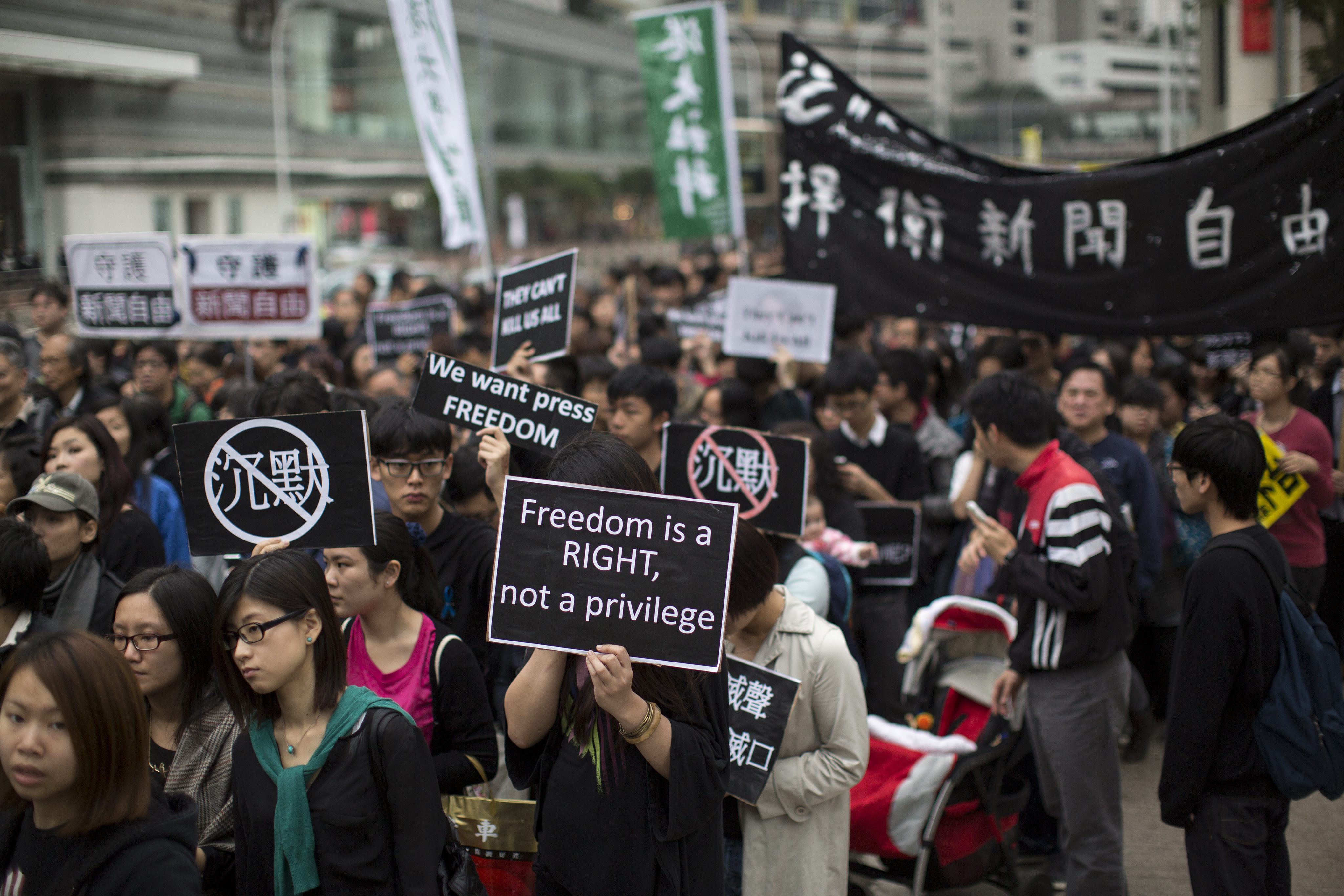
What has now changed? Since 1997 Hong Kong has been governed by China under these terms: Hong Kong would continue to operate independently of the Mainland, abide by the original English common law system, and be governed by a Chief Executive who, although elected in consultation with desires emanating from the Mainland, was expected ultimately to be chosen via election through a representative nominating committee [2]. The expectation was that beginning in 2017, elections would be free and independent, following neither the British nor Mainland styles, but rather embracing a new Hong Kong specific method [2]. Mainland China’s recent announcement that they will only allow candidates vetted by the Communist Party of China on the ballot for Chief Executive in Hong Kong has sparked uprisings throughout the city [8]. Protesters, mostly college-aged students, feel that the Mainland government’s actions violate their original commitment to universal suffrage and will forever change the character of their country [9].
In reality, much has changed in China since the original handover. The Mainland has seen huge economic growth, minted millions of millionaires, moved half their population to cities, and set up multiple special economic zones where they experiment with capitalism [3]. Hong Kong has remained a global financial capital, but income inequality has grown [4,5,6,7]. The extremely high cost of living and unsustainable population density caused many young people to despair over obtaining a high paying financial job that will allow them to afford a flat close to their workplace as well as the same lifestyle that their parents enjoyed [9]. Even before the Mainland’s policy change, the student population had become a more restive [8]. Perhaps it is easier to stand in the streets with signs protesting what one interprets as breach of promise than it is to accept the inevitable and attempt to make your way in a new world.
The struggle in Hong Kong perhaps mirrors what is going on in much of the world. We are all living in a more connected, global marketplace. Many traditional, formerly safe careers can now be outsourced. Even low skilled Chinese manufacturing is being contracted to countries where labor is cheaper. After the financial crisis of 2008, the world entered a period of falling interest rates as monetary policy was used as a potential tool to expand lending and growth [12,14]. For the past six years interest rates have been artificially held low, to zero in many parts of the world, yet costs for food, housing, and education have skyrocketed in many countries including Hong Kong [10]. Further, freedoms and privacy are eroding for many, not just in Hong Kong. Between reports of National Security Agency and other government spying, cyber-hacking, and crony capitalism in the US, Asia, and Europe; it is no wonder that people all over are feeling more unsettled as shown with the continued theme of income inequality being voiced via the 1% vs the 99% premise [13]. Students in Hong Kong want what was promised to them, namely the right to elect their own Governor [9]. They will then have the chance to implement, via elected officials, policies that will allow for more inclusive future economic growth.
So are unfettered democratic elections still possible for Hong Kong? Perhaps it is time for Hong Kong to face up to the idea that they will be inexorably pulled into a world with less meaningful free choice. It is quite unlikely that China backs down at this late date within this short of a time frame between now and the 2017 elections; it is more likely that the protests eventually fizzle out as the working population must eventually return to work and the students return to school. Nonetheless, the locals can actively work with whomever is in charge in an attempt to maintain the society and traditions they have become accustomed to. They can further show the Mainland that it is in everyone’s best economic interest to retain the status of “Asian financial capital,” and maintain the international status and importance that which Hong Kong has already achieved. No matter who governs Hong Kong, the world is changing in ways that could not be foreseen when the Basic Law was written. Hong Kong may eventually lose various bits of its culture or freedoms as it becomes subsumed into greater China. Hong Kong, like the rest of the world, will inexorably be pulled into a dynamic global stage with less meaningful free choice and more perceived inequalities or episodes of lack of “fairness.”
Given the undeniable economic importance of Hong Kong, it is not a smart political or economic move for the Mainland to allow unrest to persist and/or to institute massive changes to a system that has proven its worth. Along with dissent in Hong Kong will come increased financial uncertainty, not to mention a decrease in the foreign direct investment that has propelled Hong Kong to its current economic status. Hong Kong has not proven to be a broken system in need of changing, and the Mainland must recognize that too much imposed change will destabilize the highly profitable system.
[1] http://www.bbc.com/news/world-asia-pacific-16526765 [2] http://www.basiclaw.gov.hk/en/facts/index.html [3] http://time.com/2852740/china-millionaires/ [4] http://www.hkss.org.hk/SPC/2011-12/AwardPDF/S11-12-DP4.pdf [5] http://muse.jhu.edu/login?auth=0&type=summary&url=/journals/china/v003/3.1zhao.html [6] http://www.scmp.com/comment/article/1525874/wealth-gap-will-break-hong-kong-if-we-dont-change-economic-order?page=all [7] http://www.valuewalk.com/2014/03/singapore-hong-kong-on-income-inequality/ [8] http://www.project-syndicate.org/commentary/hong-kong-protests-governance-by-sin-ming-shaw-2014-10 [9] http://www.nytimes.com/2014/10/30/opinion/joshua-wong-taking-back-hong-kongs-future.html?_r=0 [10] http://www.chinadailyasia.com/focus/2014-03/21/content_15126303.html [11] http://hong-kong-economy-research.hktdc.com/business-news/article/Market-Environment/Economic-and-Trade-Information-on-Hong-Kong/etihk/en/1/1X000000/1X09OVUL.htm [12] http://www.usinflationcalculator.com/inflation/current-inflation-rates/ [13] http://www.brookings.edu/research/opinions/2014/02/19-affluent-squeezed-entrenched-poverty-reeves [14] http://www.bloomberg.com/markets/rates-bonds/
Photo Credit: South China Morning Post


