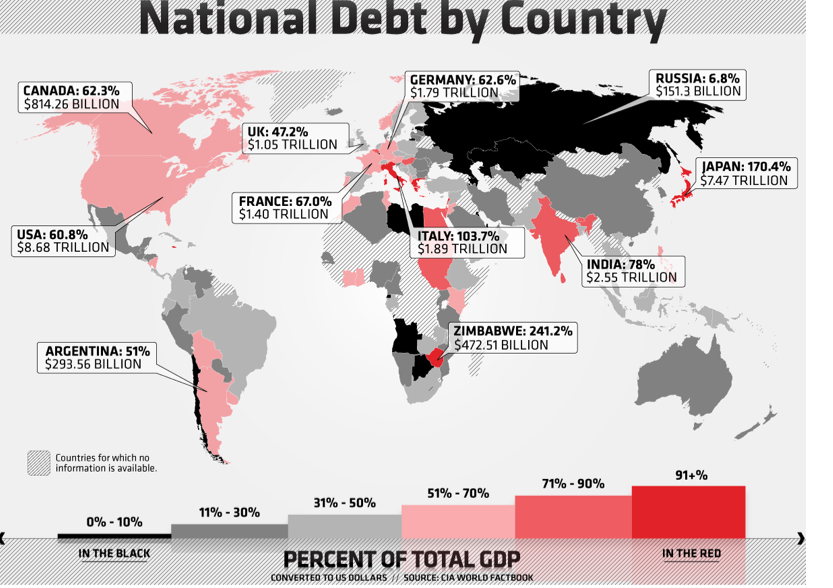
 In light of the Syrian Civil War, the Refugee Crisis it created, and the chaos in the Ukraine, the European Debt Crisis has fallen off the public radar. Greece, although receiving the lion’s share of public criticism, is far from the only country in a dangerous economic situation, and Italy will be the next domino to fall.
This is troubling because unlike Greece, Italy is currently the fourth largest economy inside of the Eurozone[1]. Its public debt rose to 132% of its GDP in the last year,[2] which is the second highest debt to GDP ratio inside of the Eurozone.[3] Meanwhile, the ranking member of the Italian Central Bank is currently being investigated under accusations of corruption and fraud.[4] Most recently, the Italian Central Bank came under fire because of the massive amounts of “Non-Performing Loans” (NPL’s), it holds, which now account for almost 1/5 of all Italian loans.[5] NPL’s are loans which, true to name, no longer realize a profit. It is a broader version of foreclosing on a mortgage.
The Italian government, to boost confidence, is attempting to sell-off these loans into the private sector.[6] A riskier loan comes with higher interest rates, because risk comes at cost. Likewise, buying a package which includes a large amount of NPL’s must be sold at discount, as private investors are wary of buying packages which may not realize a return. Demand is not high enough to justify the high prices they are being offered for. Yet Italian banks refuse to sell these loans at such discount and take the loss, so in order to encourage buyers, the Italian government has started to guarantee these loans.[7]
So in effect, the Italian government is trying to stabilize public debt by selling off its risky loan packages. It is doing this by promising to pay for them if they fail, which if they do will be paid for, naturally, by more public debt—this time, however, because the Italian government is being backed by the European Central Bank, the debt will go to the entirety of Europe, not just Italy. This is a blatant attempt to transfer risky Italian debts away from the ones responsible for creating it!
All this coming after Italy has already put massive strain on members of the Eurozone. The Eurozone requires one regional wide nominal interest rate[8]—the rate at which a government bank lends money to private citizens. However, each state has a different rate of inflation. This means that the real interest rates (what a loan will actually cost when adjusted for inflation), unlike nominal interest rates, differ wildly across the Eurozone. Germany’s real interest rate currently hovers around 8%,[9] while Italy’s is only 4%.[10] This means taking out a loan for a house or to start a business is twice as expensive as doing the exact same in Italy. Germany is essentially subsidizing Italian growth at the expense of its own.
[1] http://statisticstimes.com/economy/european-countries-by-gdp.php
[2] http://www.focus-economics.com/countries/italy
[3] http://www.debtclocks.eu/public-debt-and-budget-deficits-comparison-of-the-eu-member-states.html
[4] http://www.zerohedge.com/news/2015-10-21/italian-central-bank-chief-and-ecb-council-member-probed-over-corruption-fraud-abuse
[5] http://www.ft.com/intl/cms/s/0/7681a05a-ce39-11e5-92a1-c5e23ef99c77.html#axzz40sKo20mT
[6] https://www.dailyfx.com/forex/fundamental/daily_briefing/session_briefing/daily_fundamentals/2016/01/29/Italian-banking-sector-is-screaming-warning-signs.html
[7] http://www.theguardian.com/world/2016/jan/21/italian-prime-minister-tries-to-buoy-shares-in-italys-banks
[8] https://www.cer.org.uk/insights/eurozones-real-interest-rate-problem
[9] http://www.tradingeconomics.com/germany/interest-rate
[10] http://www.tradingeconomics.com/italy/real-interest-rate-percent-wb-data.html


![Mourners gather at a makeshift memorial to victims of the November 2015 attacks in Paris [Photo Credit: AFP/BBC]](../../../wp-content/uploads/2015/11/picture-50x50.jpg)