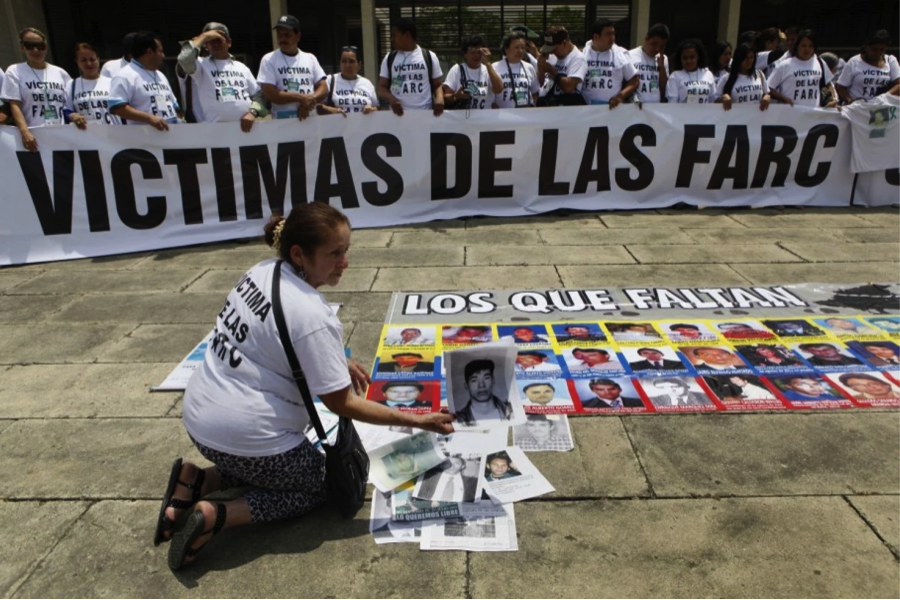
For over half a century, Colombia has been engaged in an immense internal conflict. Rooted in U.S.-backed anti-communist repression in the 1960s as well as the 1948 assassination of populist leader Jorge Eliécer Gaitán, the war has resulted in the deaths of over 220,000 people, most of them civilians. The main actors in the conflict are the Colombian government, crime syndicates, paramilitary groups, and left-wing guerillas, all of which vie for greater power and influence in their home nation. Left-wing military organization Revolutionary Armed Forces of Colombia (FARC) is one of the deadliest groups involved. Since its formation in 1964 by members of the Colombian Communist Party, FARC has been accused of a number of human rights violations, including the training of child combatants, extrajudicial executions, use of landmines, sexual abuse against its recruits, and violence against indigenous groups. Their operations are funded by drug trafficking, extortion, kidnap to ransom, and illegal mining.
FARC has since demobilized many of its guerilla fighters due to the staunch efforts of former President Álvaro Uribe Vélez, whose anti-FARC platform earned him one of the highest approval ratings of any Latin American presidency. In August of 2012, the Colombian government announced that it had begun peace talks with FARC in Havana, Cuba in an effort to end the conflict. The peace talks follow an International Criminal Court observation that demands accountability for the atrocities FARC has committed as well as pressure from local and international human rights organizations and victims demanding justice. The two sides have reached provisional agreements on three of five platforms of the talks: political participation, solving the illicit drug problem, and land negotiations.
Last Friday, FARC announced that the rebels were ready to “take responsibility” for the harm caused to the population during 50 years of war against the state. Though reaching a peace agreement that meets international obligations and gains full public support will be difficult, Colombia does appear to be on the cusp of an armistice to end Latin America’s longest-running war.
http://en.wikipedia.org/wiki/FARC#1990.E2.80.931998
http://www.bbc.com/news/world-latin-america-29841981
http://www.insightonconflict.org/conflicts/colombia/
http://www.theguardian.com/world/2014/oct/24/farc-colombia-rebel-leaders-negotiations-havana
http://www.washingtonpost.com/blogs/monkey-cage/wp/2014/08/28/pitfalls-abound-in-colombia-farc-peace-talks/
Photo Credit: http://www.abc.com.py/fotos/foro-nacional-sobre-victimas-de-las-farc-1272830.html

![Barack Obama and Raúl Castro shake hands as they meet for the first time at the 2015 Summit of the Americas in Panama [Photo Credit: Reuters]](../../../wp-content/uploads/2015/12/image-resizer-50x50.jpg)
![Macri celebrates winning enough votes to force Argentina into a runoff election [Photo Credit: AFP]](https://keckjournal.com/wp-content/uploads/2015/11/arg-50x50.jpg)
