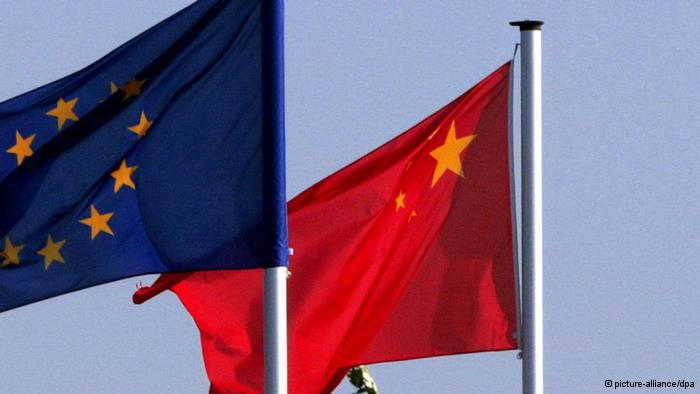
Last month, the European Union and China struck a deal ending a dispute long standing dispute over China’s telecom giant Huawei. The company had been accused of being the recipient of government aid to increase its competitive edge in the global economy. Trade relations are at an all-time between the EU and China, the EU is China’s largest trading partner and China is the EU’s second largest trading partner. China’s Xi Jinping’s vision for an economic ‘New Silk Road’ extends into Central and Eastern Europe. Incidentally, located in those two regions are countries with plenty of interest in trading with China. Xi Jinping embarked on a European tour earlier this year, visiting potential and existing trading partners. European leaders have been flying east also. Trade flows between the two regions have topped $1 million and are only expected to go higher. Trading with China comes at a cost though.
Allowing Chinese companies into European markets opens the door to companies owned or subsidized by the state, leading to less competitiveness for European companies. The Huawei dispute is one example, another being the changes that the market over solar glass have undergone. In 2009 the price of a square meter of solar glass had been $10.40. By 2014 it was $4.60, a decrease in over half of its monetary value. Chinese suppliers, with subsidies from their government, flooded the market and European companies suffered.
There is also a political cost to trading with China. The EU is an organization not exactly known for its unity, the twenty or so countries which make up the Union struggle to unite their policies. China has taken advantage of this, most of the trade agreements with European countries have been bilateral ones. The development of relations between the China-Central and Eastern Europe group focus on a diverse yet geographically specific set of countries. Smaller countries feeling marginalized in the EU such as Romania are given an economic door into China while bigger states struggling with the recession such as Poland are able to gain with trade. If anything confrontational happens with China though, it will be harder for the EU to adopt a unified front because of these bilateral trade flows.
Human rights is an issue that the EU has prided itself on, being an adamant supporter for human rights across the globe. Yet the EU is trading with China, a country with a poor human rights record. Faced with choosing between human rights concerns and economic concerns, it seems many European countries have chosen to focus on the latter. A blind eye has been turned by most countries towards China’s human right’s abuses, a tragic contradiction that Europe may end up regretting. As Europe grows closer to China, it only involves itself deeper with a growing and ambitious power. Events it could once ignore thanks to geographical distance will requires the organization’s attention. The EU’s deep relations with the United States and China will be a cause of trouble for the European community if those two countries end up going head to head.
Photo Credit: Embassy of China in Frankfurt
Aaron Yang

Aaron is a freshman from Chandler, Arizona and is interested in International Relations and hopes to focus in East Asia. He is also a passionate fan of Doctor Who, Sherlock, House of Cards, Game of Thrones, and Code Geass. If you see him on campus, bring him a boba and you'll get lots of love!
![Migrants at a train station in Dortmund, Germany. [Photo Credit Times of Israel/AP Photo/Martin Meissner]](https://keckjournal.com/wp-content/uploads/2015/09/Germany-Migrants_Horo-4-635x357-50x50.jpg)

