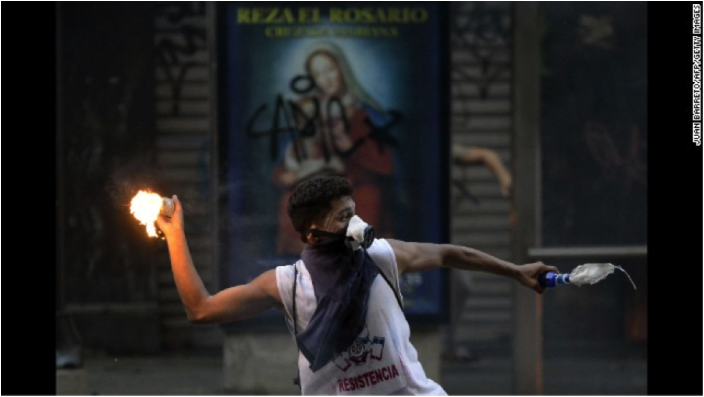
Venezuela captured global attention mid-February when violent demonstrations resulted in the shooting of three individuals after a peaceful march in Caracas, the country’s capital. The anti-government protests have been fueled by economic and social turmoil as well as rampant crime activity: Venezuela suffers the fifth-largest murder rate in the world, severe basic food shortages, and record yearly inflation of 56.2% as of 2013.
International media coverage of the violence in Venezuela has been spotty. Journalists have been attacked by protesters and police alike, arrested, and according to Venezuelan news source El Mundo, five were “beaten and hurt by the national guard.” Meanwhile, protesters have accused President Nicolas Maduro of issuing a media blackout in an attempt to quell criticism of his government. Perhaps as a result of the resulting unreliable information, international media has reported relatively little on the protests.
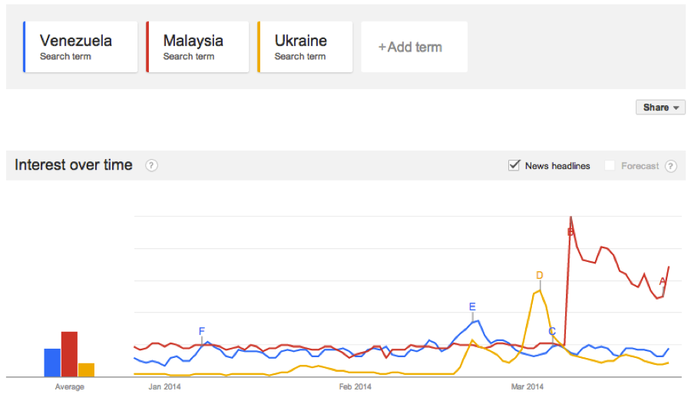
The graph above demonstrates the popularity of three Google search terms in the past 90 days related to recent current global events: the protests in Venezuela, the missing Malaysian aircraft, and the Russia-Crimea-Ukraine conflict. Though search trends do not provide a complete picture, the data does provide an insight into the issues that lie at the forefront of the media and global interest. The search term “Venezuela”, designated as the blue line, enjoys a brief period of activity around the height of the protests in February, then quickly returns to its previous level by March.
The trends are more pronounced when filtered by searches performed within the U.S.
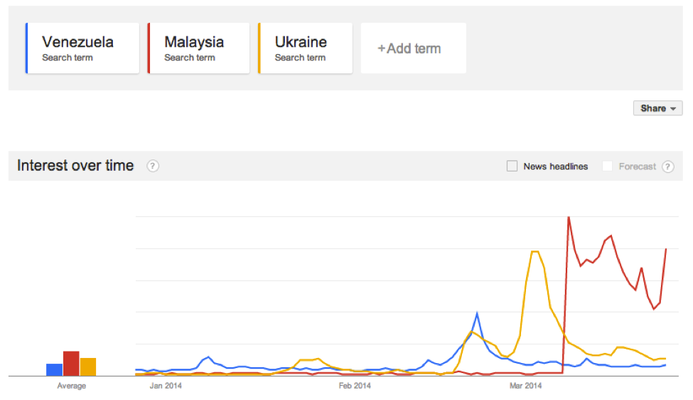
Despite the lack of global spotlight, increasingly violent demonstrations have continued to ravage Venezuela. At least 32 people have now been killed in the protests, according to Aljazeera. However, recent interest in Venezuela has been overwhelmed by coverage of current events elsewhere, those seemingly more relevant to the U.S. This follows a long tradition of underrepresentation of Latin America in the media, resulting in lack of knowledge of the region’s historically violent struggle for social justice.
Sources for images and information:
http://www.cnn.com/2014/02/20/world/americas/venezuela-qa/
http://www.bbc.com/news/world-latin-america-26335287
https://knightcenter.utexas.edu/blog/00-15163-national-press-syndicate-venezuela-denounces-attacks-against-journalists
http://www.aljazeera.com/news/americas/2014/03/death-toll-rises-venezuela-protests-20143250332825264.html
Graphs courtesy of Google Trends


