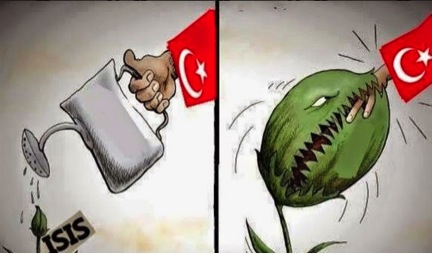
The Islamic State in Iraq and al-Sham, or ISIS, is a terrorist organization of 17,000 people and with funds estimated to be as high as 2 billion USD. ISIS wants to establish a caliphate comprising of territory in Iraq, Syria, and Turkey amongst other Middle Eastern countries (Mistzal). In order to accomplish this goal, they use extreme violence and follow Sharia law to a tee. At present, they are fighting a fierce battle in Kobani, a town on the Turkish-Syrian border, against Kurds from Syria, Turkey, and Iraq. These Syrian, Iraqi, and Turkish Kurds inhabit a region unofficially known as Kurdistan due to the high proportions of Kurdish peoples there. Many of these Kurds hope that by fighting ISIS and taking advantage of instability in Iraq, they can make Kurdistan an official country. Indeed, due to the chaos in Iraq, Iraqi Kurdistan is already more or less an autonomous region, further exacerbating Turkey’s fears and the hopes of Kurds in the greater Kurdistan area (Filkins).
Turkey does not like this greater autonomy.
Turkey is worried about an insurrection amongst its citizens of Kurdish nationality, and is thus making it difficult for Iraqi Kurds to get to Kobani and fight ISIS. In essence, Turkey is helping ISIS, and many in this organization even see Turkey as an ally; a former member of ISIS has claimed that Turkish officials actively help members of ISIS across the Turkish border in order to combat the Kurds (Guiton). For a developed, civilized country that is a candidate for EU membership, this covert collaboration is unacceptable. The EU should send a clear message to the world and immediately reject Turkey as a prospective member country.
Whether Turkey has actually ever had a chance of joining the EU is itself debatable. Turkey’s relationship with the EU dates back to 1959, when Turkey applied for an associate membership with the European Economic Community, the EU’s predecessor. Since then, Turkey has entered into a customs union with the EU and in 1999 applied to become a member of the EU, but never has truly come close to becoming a full-fledged EU member (EU-Turkey). There are a number of reasons for this. Firstly, Turkey is more associated with Asia than with Europe. Secondly, Turkey is a nation in which the predominant religion is Islam, making Turkey an outlier in the often-xenophobic European community. And, thirdly, in order to join the EU, a country must meet certain standards known as the Copenhagen Criteria. Turkey does not meet the first objectives of the Copenhagen criteria.
The first criterion requires a member country to be domestically fair and not abuse human rights. Turkey did not do this very well before the ISIS crisis—not apologizing for the Armenian genocide, not allowing freedom of religion in the name of secularity, etc.—but Turkey’s reaction to ISIS has made things much worse (Cavanaugh). Before the rise of ISIS, Turkey had been making peace with Kurds and their party, the Kurdistan Workers’ Party (P.K.K.). However, Turkish Prime Minister Erdoğan is now afraid that the Kurds will try to seek their independence. Thus, he has recently launched attacks against Turkey’s Kurdish population, has not been very cooperative in letting Kurds join the fight in Kobani, and has allowed ISIS to flourish (Krajeski). Some 3,000 Kurdish political activists are incarcerated in Turkish prisons. Kurds are treated like second-class citizens and are often prohibited from speaking Kurdish. And, the Turkish army is known to drop bombs on P.K.K. fighters (Cheikosman). Turkey’s army has also in general played an unhealthy role in government affairs. If it disagrees with government policies or thinks that the government isn’t secular enough, the military will initiate a coup d’état. Although the military has been reined in somewhat under Erdoğan, it still promotes instability and oppression in Turkey (Cavanaugh).
The second Copenhagen criterion requires a member country to have a stable economy. Turkey’s economy has always been somewhat unstable, and this instability can only be exacerbated by the ISIS crisis.
The abuses that Turkey has committed and continue to commit, in light of Turkey’s already low chances of joining the EU, are a sign that perhaps Turkey should not be allowed into the union. As such, the most appropriate plan of action is for the European Union to reject forthwith Turkey’s application for membership. This will not blatantly hurt the European Union, as Turkey would, for aforementioned reasons, never have allowed Turkey to join its ranks (Warner). It will, however, send Turkey a clear message laced with definitive action that its behavior with regard to the terrorist group, ISIS, will not be tolerated. The EU must let Turkey know that suppressing Kurds and other minority groups will not be tolerated by the Western world. ISIS should be shown that the Western world is serious in its resolve to deal with them. And maybe, just maybe, all of this will show the Kurds and other minority groups around the world that they should fight for self-determination, should fight for fair representation, should fight for democracy. Should we expect anything less from the West?
Works Cited
Cavanaugh, Chase. “Turkey’s Difficult Entry into the European Union.” Turkey’s Difficult Entry into the European Union. Thewashingtonreview.org, Feb. 2011. Web. 09 Nov. 2014. <http://www.thewashingtonreview.org/articles/turkeys-difficult-entry-into-the-european-union.html>.
Cheikosman, Evin. “Turkey’s Violations to Human Rights towards Kurds: A Hindrance on Admittance to the EU.” Ekurd.net. Kurd Net Daily Online Newspaper, 3 Jan. 2013. Web. 21 Nov. 2014. <http://www.ekurd.net/mismas/articles/misc2013/1/turkey4388.htm>.
“Conditions for Membership.” European Commission. European Union, n.d. Web. 07 Nov. 2014. <http://ec.europa.eu/enlargement/policy/conditions-membership/index_en.htm>.
Delfs, Arne. “Turkey Unfit to Join EU, Says Merkel Europe Parliament Candidate.” Bloomberg.com. Bloomberg, 10 Apr. 2014. Web. 09 Nov. 2014. <http://www.bloomberg.com/news/2014-04-10/turkey-unfit-to-join-eu-says-merkel-europe-parliament-candidate.html>.
“EU-Turkey Relations.” European Commission. European Union, n.d. Web. 09 Nov. 2014. <http://ec.europa.eu/enlargement/candidate-countries/turkey/eu_turkey_relations_en.htm>.
Filkins, Dexter. “ISIS vs. the Kurds.” The New Yorker. Condé Nast, 29 Sept. 2014. Web. 08 Nov. 2014. <http://www.newyorker.com/magazine/2014/09/29/fight-lives>.
Guiton, Barney. “‘ISIS Sees Turkey as Its Ally’: Former Islamic State Member Reveals Turkish Army Cooperation.” Newsweek. IBT Medi, 7 Nov. 14. Web. 07 Nov. 2014. <http://www.newsweek.com/isis-and-turkey-cooperate-destroy-kurds-former-isis-member-reveals-turkish-282920>.
Krajeski, Jenna. “What Kobani Means for Turkey’s Kurds - The New Yorker.” The New Yorker. Condé Nast, 8 Nov. 2014. Web. 08 Nov. 2014. <http://www.newyorker.com/news/news-desk/kobani-means-turkeys-kurds>.
Mistztal, Blaise. “An Overview of ISIS Threat and U.S. Response.” Bipartisan Policy Center. N.p., 25 Sept. 2014. Web. 06 Nov. 2014. <http://bipartisanpolicy.org/blog/foreignpolicy/2014/09/25/overview-isis-threat-and-us-response>.
“Turkey-EU Relations.” Republic of Turkey Ministry of Foreign Affairs. Turkey, n.d. Web. 09 Nov. 2014. <http://www.mfa.gov.tr/relations-between-turkey-and-the-european-union.en.mfa>.
Warner, Gerald. “Turkey Is Complicit with ISIS and Unfit to Join the EU.” Breitbart. Breitbart News Network, 21 Oct. 2014. Web. 09 Nov. 2014. <http://www.breitbart.com/Breitbart-London/2014/10/22/Turkey-Is-Complicit-with-ISIS-and-Unfit-to-Join-the-EU>.
Photo Credit: Bare Naked Islam

![Migrants at a train station in Dortmund, Germany. [Photo Credit Times of Israel/AP Photo/Martin Meissner]](https://keckjournal.com/wp-content/uploads/2015/09/Germany-Migrants_Horo-4-635x357-50x50.jpg)

