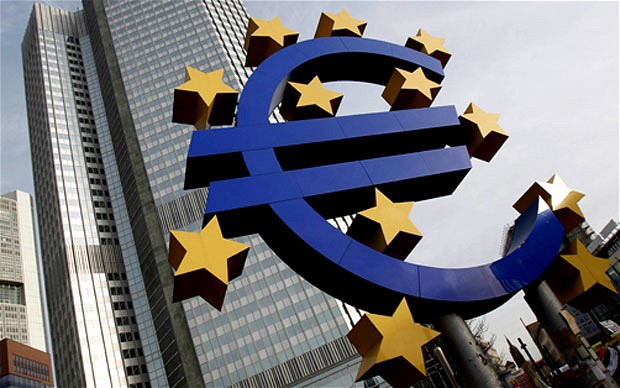
Near the beginning of this year, the European Banking Authority (EBA) announced a new round of stress tests for the Eurozone for the first time since 2011 [1]. The results, published recently on October 26, are an assessment of how resilient Europe’s biggest banks will be in response to possible shocks to the system [2]. The report is also meant to restore confidence in the European Union’s banking sector and test the credibility of the European Central Bank (ECB), which helped conduct the review and will take over supervision of the Eurozone banks on November 4 [3][4].
This stress test was designed to be more thorough and rigorous than its predecessors, in an effort to be more convincing and encourage more investment and lending from the “healthy” banks [3][4]. One of the key figures of the test is the capital ratio, which compares the amount of capital to the total risk exposure for each bank [5]. The capital ratio shows how much of the bank’s financing comes through its own cash flows and how much comes through riskier borrowed funds, which are unreliable if a crisis were to occur [4]. According to the data collected at the end of 2013, the average capital ratio for the 123 banks tested was 11.5%, adjusted to 11.1% after an asset quality review [6]. In an adverse scenario, the capital ratio falls to 8.5% - the threshold for European banks to pass the stress test [6].
While some economists saw the test as a way for people to finally get a clear picture of the state of European banks, others were more cynical. For example, the New York Times negatively compared this round of stress testing to the 2009 United States test, which was designed so that banks could not cut lending or securities holdings to meet the required capital ratios [2][4]. Although the ECB has emphasized how thorough and rigorous its review has been, they have been forced to compromise several times throughout the process - information during the process was disclosed to banks in order to prevent consequences of keeping the banks in the dark, which could have led to an extreme decrease in lending and too little risk taking; national supervisors tried to protect their countries’ banks while working with the ECB; the deadline for bank balance sheets was moved from December 2013 to March 2014, using the new data to save banks that would have otherwise failed [7][8]. However, most of these concessions represented the ECB becoming more “realistic,” in order to earn cooperation from the banks, which it will soon be overseeing [8]. Overall, criticisms have not hugely affected the credibility and new start for the ECB.
Results, using data from the end of 2013, showed that 24 out of the 123 banks, roughly one-fifth of the sample size, failed the stress test, and out of those 24 banks, only 14 still have shortfall – “falling short” of the required minimum of capital [6]. The other 10 banks have, since the end of 2013, gathered enough capital to be considered safe, and are thus only “technical failures” [6]. The remaining 14 banks only have to raise a combined 10 billion Euros to have the requisite amount of capital [9]. Italy had the most banks that failed the test; other countries that had banks in shortfall include Austria, Belgium, Cyprus, Greece, Ireland, Portugal, and Slovenia [10]. These banks have two weeks to come up with a catch-up plan to present to the ECB, and six to nine months to implement their plans and fix their finances [3]. If unable to close the gap by the deadline, the banks will be forced to shut down.
Looking at the results, there were few failures and surprises, as predicted by some investors; JP Morgan, for example, expected second-tier lenders to fail, and to have a number of failures that were merely technical, as described above [3]. Overall, the organizations that conducted the test are hoping that findings will encourage healthy banks to increase lending to European corporations, which fell by over 10% during the 2008 financial crisis [4]. Analysts also hope that U.S. investors, who have always held low levels of European bank equity, will be willing to invest more money and increase capital and cash flow [7]. Currently, there is only a slight increase in demand, but many bank officials and analysts are tentatively positive about the results and what they will mean for the future of banking in Europe [11].
On the flip side, BBC has voiced concerns about the predicted effectiveness of test results on the economy, stating that such a test has been overdue for a couple years, and will no longer have the impact it could have had, had the test been carried out earlier [12]. BBC has also highlighted the Eurozone’s problem not being about banks’ supplies of capital, but about the demand for credit, which has been dwindling as households and businesses have been unwilling to borrow; in other words, the Eurozone’s main issue is its inability to generate credit, not its levels of monetary funds [12].
Looking at all sides of the argument from different sources, it appears that the Eurozone’s future is still up in the air, to be decided by the way that the ECB decides to run the banks from now, by how much trust and money that investors decide to put into the European economy, and by the attitudes the banks will hold towards lending and sustainable risk-taking. It will still be months before the countries in the Eurozone, along with the rest of the world find out whether or not the banks that failed have made up their missing capital – fortunately, this is expected to end positively, as the amount of missing capital is far from exorbitant, and the other “technical failures” have already been able to clean up their balance sheets in several months’ time.
[1] https://www.eba.europa.eu/risk-analysis-and-data/eu-wide-stress-testing/2014
[2] https://www.eba.europa.eu/risk-analysis-and-data/eu-wide-stress-testing/2014/the-eba-s-role-in-the-eu-wide-stress-test
[3] http://www.reuters.com/article/2014/10/26/us-eu-banks-preview-idUSKCN0IF01Y20141026
[4] http://dealbook.nytimes.com/2014/10/27/e-c-b-stress-tests-seen-as-bolstering-confidence-in-banks/?_php=true&_type=blogs&_r=0
[5] https://www.eba.europa.eu/risk-analysis-and-data/eu-wide-stress-testing/2014/the-eba-s-role-in-the-eu-wide-stress-test
[6] https://www.eba.europa.eu/documents/10180/851779/2014%20EU-wide%20ST-aggregate%20results.pdf
[7] http://www.reuters.com/article/2014/10/23/us-eu-banks-idUSKCN0IC12120141023
[8] http://www.reuters.com/article/2014/10/20/us-ecb-banks-tests-idUSKCN0I90BD20141020
[9] http://www.bbc.com/news/business-29784496
[10] http://www.bbc.com/news/business-29777589
[11] http://www.reuters.com/article/2014/10/26/us-eu-banks-idUSKBN0IF0BF20141026
[12] http://www.bbc.com/news/business-29784496
Photo Credit: Telegraph UK


![Migrants at a train station in Dortmund, Germany. [Photo Credit Times of Israel/AP Photo/Martin Meissner]](https://keckjournal.com/wp-content/uploads/2015/09/Germany-Migrants_Horo-4-635x357-50x50.jpg)
