Four years ago at the FIFA World Cup, South Africa was at the height of international acclaim. With the eyes of the world upon them, the country delivered. The games were seen as an overall success with little to scrutinize and attracted positive media attention. As everyone celebrated the success of the games, South Africa had a lot to be happy about: a peaceful and well-run tournament as well as a growing economy. While developed economies in the West were in recession, foreign investors turned their attention to diversifying away from these regions and began to increase capital in developing economies. According to Jesse Colombo of Forbes Magazine, the low interest rates in developed economies caused “4 trillion of speculative ‘hot money’ to flow into emerging market investments.”[i] These growing markets included several countries, mainly Brazil, Russia, India, China and South Africa, which were coined BRICS. South Africa joined this group as the economy benefited from the increase in capital and the demand for currency. This steady acceleration in developing economies allowed for great growth during this time.
When Ben Bernanke, speaking for the Federal Reserve, discussed the possibility of tapering quantitative easing last May he changed the course of foreign investment in developing economies. The Federal Reserve essentially hinted that the U.S economy was once again growing and in the near future might not need strong government intervention. This sudden announcement led investors to pull money from emerging markets at a rapid pace in order to reinvest in the recovering Western economies. According to EPFR Global, “more than $19 billion left funds investing in developing-nation assets in three weeks.”[1] This shocked the economy of many countries, including South Africa, as this dramatic withdrawal of funds affected currencies all over the world. The South African rand fell 2.9 percent in three weeks and almost reached the lowest value since 2009.[2] The unexpected removal of foreign investment started a cycle of economic problems for South Africa.
One main issue for the economy of South Africa is its relation with European markets. Certain European countries, such as the United Kingdom, expect growth that will direct further foreign investment away from developing markets. In order to recover from this loss, South Africa must increase exports to the European Union. However, many exports are value-added products that have not seen a significant increase with the improvement of Western economies. Though South Africa can expect exports to increase as European markets grow, the recent tensions between the EU and Russia might cause growth to stagnate once again. Without the added benefit of increased exports, the flight of capital to European markets only causes further problems for South Africa.
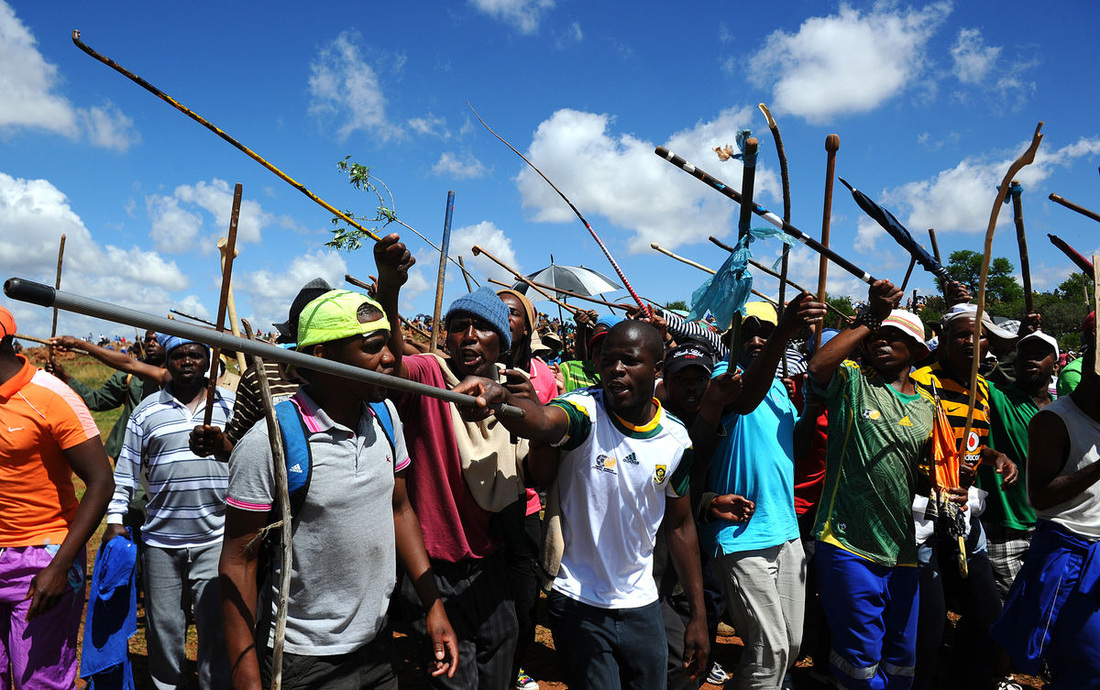
Compounding the situation is the lack of foreign direct investment (FDI) in South Africa, as the country is not attracting new investment directly into local businesses. Reasons for decreased FDI can also be tied to the recent credit downgrading within the past few years. Credit rating agencies assessed that South Africa struggled with labor unrest due to protests and strikes. There have been several protests against youth unemployment rates; however, the most publicized have been the platinum strikes. On August 16, 2012 police officers killed thirty-four protesting miners, which led to negative publicity that has followed the unsuccessful protests. Currently there are more than 70,000 miners who have been on strike since January 23.[3] This prolonged strike has caused companies to consider leaving the market in South Africa. The unpredictability of the labor market has portrayed the economy as an unstable location for foreign investment. Another issue that could lead to a further downgrading is the increased corruption in the country. After the Nkandla scandal in which President Jacob Zuma was accused of corruption, the country could slip further down the corruption perception index, which would further devalue the rand.
The continued stagnation of exports as well as the capital outflow, lack of FDI, and credit devaluation has led to inflation. Many other developing countries are also struggling with inflation, as prices are volatile in all of BRICS economies. In order to combat these issues, BRICS are trying to create a development bank that would support infrastructure as well as create a fund designed to steady currency in these markets. Though these initiatives have been slow moving, they would provide support for South Africa and potentially prevent future sudden shifts in the market. Though there seemed to be great hope for South Africa in 2010, today the outlook is more sober as the country attempts to stabilize the economy, bring back investment and increase exports in order to reestablish their image in the international market.
[i] Colombo, Jesse. “A Guide to South Africa’s Economic Buble and Coming Crisis.” Forbes Magazine, March 19, 2014. http://www.forbes.com/sites/jessecolombo/2014/03/19/a-guide-to-south-africas-economic-bubble-and-coming-crisis/ (accessed April 11, 2014).
[1] Xie, Ye, and Michael Patterson. Bloomberg, “Emerging Markets Crack as $3.9 Trillion Funds Unwind: Currencies.” Last modified June 20, 2013. Accessed April 11, 2014. http://www.bloomberg.com/news/2013-06-20/emerging-markets-crack-as-3-9-trillion-funds-unwind-currencies.html.
[2] Xie, Ye, and Michael Patterson.
[3] Wild, Franz, and Amogelang Mbatha. Bloomberg, “South Africa Shale-Boom Outcome Won’t Mirror Mining Says ANC.” Last modified April 09, 2014. Accessed April 11, 2014. www.bloomberg.com/news/2014-04-08/south-africa-s-anc-says-shale-boom-outcome-won-t-mirror-mining.html.


