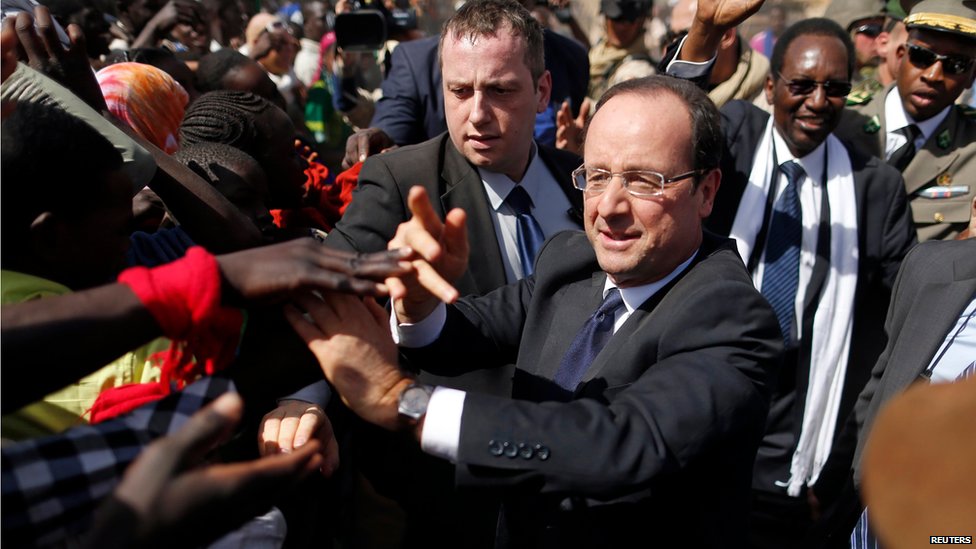
French military intervention in its former military colonies, for better or for worse, is nothing new. The country’s track record of intervention is by no means a clean state, one example being the 1994 Rwanda Genocide which the country has been accused of not preventing. But France’s deployments of troops last year into Mali and into the Central African Republic (CAR) seem to have marked a dramatic turn in the country’s approach to intervention. Operation Serval in Mali is being viewed as a success by the international community for defeating radical Islamists and stabilizing the country. French troops deployed in the CAR have received international support in their efforts to disarm militants and prevent religious violence. Today, the UN Security Council unanimously approved the creation of an UN-led mission to take over from the currently deployed African Union and French soldiers. Unlike military interventions in France’s past and those of the US and most recently Russia, France’s two recent deployments have received little backlash from the international community. Why?
This can be attributed to two reasons. The first is that France has been able to positively portray its military intervention as being genuinely motivated to protect citizens and restore order. France authorized Operation Serval with the goal of supporting the Mali government to reclaim territory occupied by Islamist terrorist groups and prevent the creation of a terrorist state. In the CAR, French troops were deployed to disarm the Seleka and anti-balaka religious militias to restore order. France was able to project that it was intervening to restore order, not to exploit resources in the embittered countries or retake the former African colonies, and able to win public opinion for doing so. It appeared that France was acting out of a genuine interest to protect human rights.
The second reason can be attributed to the timing of France’s interventions. Operation Serval was authorized after Mali requested French support and also after UN resolution 2085 was passed which encouraged international support to protect the sovereignty of Mali. In the CAR, France intervened only after the UN approved an African Union-led mission. It should be noted though that France did not order its forces to intervene until after the Bozize regime was overthrown by Seleka rebels, even after the regime’s request for support. In Mali and the CAR, France did not intervene unilaterally and only intervened with international or regional support.
France’s military interventions in Mali and the CAR have escaped international backlash by being portrayed as multilateral, internationally and regionally supported humanitarian actions needed to preserve stability. The steps France took before intervening in Africa allowed the country to avoid a repeat of the condemnation it received after the 1994 Rwanda Genocide, and allowed the country to uphold its image as a protector, not an imperialist.
Aaron Yang

Aaron is a freshman from Chandler, Arizona and is interested in International Relations and hopes to focus in East Asia. He is also a passionate fan of Doctor Who, Sherlock, House of Cards, Game of Thrones, and Code Geass. If you see him on campus, bring him a boba and you'll get lots of love!


