In a letter to John Kerry on April 4th, the Executive Director of Human Rights Watch urged the Secretary of State to withhold permission for resumption of U.S. military aid to Egypt. The letter cites numerous examples of Egypt’s failure to move toward democratic governance under its current military rule, including violations of the right to assembly guaranteed in the new Egyptian Constitution and the sentencing of 529 people to death on March 24.[1] Egypt’s move away from meaningful progress toward democracy has done little to change U.S. aid policy in the country, just as Hosni Mubarak’s thirty years in power did not dissuade the United States from maintaining close ties with the North African nation.
President Obama suspended parts of the United States’ annual $1.5 billion aid package to Egypt following the Egyptian military’s July 2013 ouster of democratically-elected President Mohamed Morsi.[2] However, Obama has been hesitant to classify this transition of power as a coup, the designation that would require the United States to cut off all but humanitarian aid to Egypt.[3] In spite of the military government’s dubious commitment to its new constitution, the Obama Administration has been eager to end the aid suspension. Delivery of U.S. military aid, it seems, is not solely contingent upon the recipient’s apparent commitment to its citizens’ human and civil rights.
The U.S. began its aid program in Egypt in the late 1970s.[4] Egyptian president Anwar Sadat broke off the close relations that his predecessor, Gamal Abdel Nasser, had fostered with the Soviet Union.[5] Sadat’s turn away from the USSR allowed the United States the opportunity to establish and strengthen a relationship with one of the Middle East’s most important regional powers. At the time, the United States valued a relationship with Egypt not only as a counterpoint to Soviet influence, but also as a strategically-located Arab nation willing to make peace with Israel. After several devastating wars against Israel, Egypt desperately needed to rebuild its military. The customary U.S. aid package to Egypt was thus born out of Egypt’s need for financial and military resources, and the geostrategic power play that prompted the United States to seek influence in the Middle East.
The U.S. aid commitment to Egypt is considerable. From 1948 to 2011, the United States granted Egypt around $71.6 billion dollars in military and economic aid, making it the second-largest recipient of U.S. aid over the period.[6] The frequency of aid packages to Egypt does not mean that they are without scrutiny. U.S. policymakers regularly call this aid allotment into question on the basis of the Egyptian government’s authoritarian record. Recently, members of Congress from both sides of the aisle have expressed their desire to continue withholding aid from Egypt until the state begins to make clear moves toward establishing a system of democratic governance.[7] In part, this response results from the frustrations of their constituents, who feel that their money is being wasted on a government with alien values. President Obama and Secretary of State Kerry, on the other hand, continue to hedge around the issue. As the United States’ primary decision makers in the foreign policy arena, they must take into account the long-term effects of alienating Egypt. One such effect could be a turn by Egypt to Russia. Additionally, if the United States decides to decrease its financial sway over Egypt, it will forgo one mechanism of inducing Egypt to coexist with Israel.
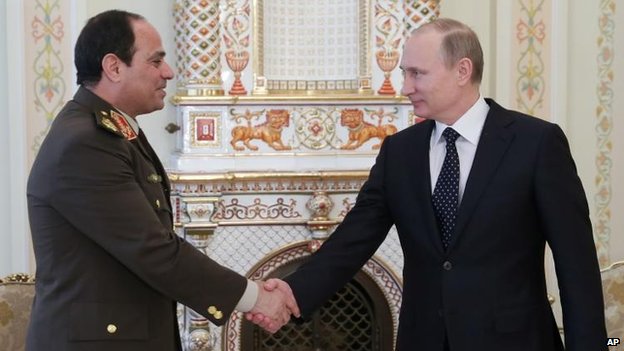
The Obama Administration is acutely aware of the necessity of providing Egypt the aid that it desires if the U.S. wishes to remain a benefactor with any political clout. Abdel Fatah al-Sisi, Egypt’s former defense minister who is now seen as the front-runner in Egypt’s May 2014 presidential election, has made clear to the United States that he will not hesitate to meet Egypt’s need for military funding through a relationship with another patron – Russia. In February 2014, the then-defense minister visited President Putin in Moscow. The official purpose of the visit was to discuss a $2 billion arms deal.[8] In the face of the delay in U.S. military aid to Egypt, the visit was also intended to send a clear message to the United States: if the U.S. refuses to provide aid, Egypt will seek it elsewhere.
As the United States seeks to navigate its relationships with nations in the Middle East, it has consistently found Russia to be one of its main adversaries in achieving its goals. Russia continues to frustrate the United States and its Arab allies through its alliances with Syria and Iran, the two “black sheep” of the Middle East. Allowing Putin to gain a foothold in its relationship with Egypt, a historically powerful player in the Arab world, would signify a major loss for the United States in a quest for hegemony that is reminiscent of the Cold War.
Israel, another longtime U.S. ally in the region, considers U.S. military aid to Egypt one of the pillars supporting the 1979 Egyptian-Israeli Peace Treaty. As Israeli Prime Minister Benjamin Netanyahu explains, “[Israel’s] interest is basically having the peace with Egypt continue…that peace was premised on American aid to Egypt, and I think that for us is the most important consideration, and I’m sure that’s taken under advisement in Washington.”[9] Netanyahu expresses what President Obama cannot – that U.S. aid, particularly military aid, is primarily a function of strategic reasoning rather than a reward for compliance with humanitarian values.
Nongovernmental organizations such as the IMF enjoy the privilege of giving money conditionally, and United States law does lay out certain conditions that must be met before country can receive its aid. However, while NGOs have the advantage of not functioning on the basis of competition, the reality for the United States is that withholding funding could open space for another state to provide it. While Russia is by no means considered a superpower in the contemporary international system, it has recently been flexing political muscles under Putin’s leadership. The United States must face the reality that if it refuses to grant Egypt the military aid to which it is accustomed, Egypt may seek a patron that, in the eyes of the U.S., yields a far less desirable influence in the region.
In spite of this probability, the United States should choose to exercise true global leadership and express its commitment to human rights for all Egyptians by withholding military aid from a government that denies rights to those it disagrees with. For too long, the United States has acted inconsistently with its values in the Arab world. The Egyptian people will have far more respect for a United States whose actions match its words and who responds to their needs. When those people do gain a political voice, perhaps they will remember when the United States acted as their – and not their dictator’s – friend.
[1]Kenneth Roth, “Letter to Secretary Kerry on US Military Aid to Egypt,” Human Rights Watch, April 4, 2014,http://www.hrw.org/news/2014/04/03/letter-secretary-kerry-us-military-aid-egypt.
[2]Elise Labott, “U.S. suspends significant military aid to Egypt,” CNN, October 9, 2013, http://www.cnn.com/2013/10/09/world/meast/us-egypt-aid/.
[3]Labott, “U.S. suspends significant military aid to Egypt.”
[4]“History,” USAID, last updated February 24, 2014, http://www.usaid.gov/egypt/history.
[5]Carol Williams, “Amid U.S.-Egypt chill, Sisi seeks military assistance from Russia,” Los Angeles Times, February 13, 2014, http://articles.latimes.com/2014/feb/13/world/la-fg-wn-russia-egypt-sisi-putin-20140213.
[6]Brad Plumer, “The U.S. gives Egypt $1.5 billion a year in aid. Here’s what it does,” Washington Post, July 9, 2013, http://www.washingtonpost.com/blogs/wonkblog/wp/2013/07/09/the-u-s-gives-egypt-1-5-billion-a-year-in-aid-heres-what-it-does/.
[7]Julian Pecquet, “Congress threatens showdown over military aid to Egypt,” al-Monitor, March 17, 2014, http://www.al-monitor.com/pulse/originals/2014/03/congress-egypt-military-aid-showdown-us.html.
[8]“Putin backs Sisi ‘bid for Egypt presidency’,” BBC, February 13, 2014, http://www.bbc.com/news/world-middle-east-26171142.
[9]Isabel Kershner, “Israel Expressed Dismay at Cutback of U.S. Aid to Egypt,” The New York Times, October 9, 2013, http://www.nytimes.com/2013/10/10/world/middleeast/israel-us-egypt.html?_r=0.


